
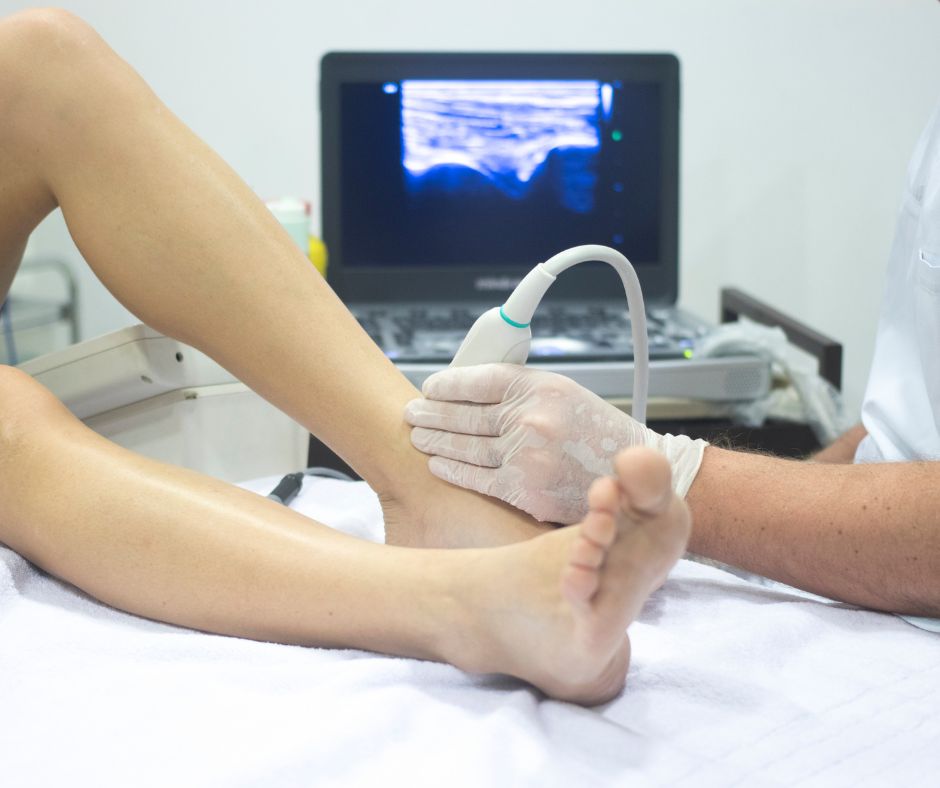
Ultrasound, including point-of-care ultrasound (POCUS), is an increasingly valuable tool in the assessment of foot and ankle pathology. It provides dynamic, real-time imaging of soft tissue structures and can be particularly useful in guiding diagnosis and management in both acute and chronic presentations.
Ultrasound is well suited to evaluating tendons, ligaments, bursae, and superficial soft tissue structures. Common indications include suspected Achilles tendinopathy, plantar fasciitis, peroneal tendon pathology, ligament injury following ankle sprain, and assessment of soft tissue masses or Morton’s neuroma. The ability to perform dynamic assessment allows clinicians to evaluate structures during movement, which can be particularly helpful in identifying instability or subluxation.
POCUS can be especially useful in clinical settings where rapid decision-making is required. It allows immediate correlation of imaging findings with clinical examination, supporting more targeted management. In experienced hands, it can also be used to guide interventions such as injections with greater accuracy.
Referral for ultrasound should be considered where there is a need to clarify soft tissue pathology, particularly when symptoms persist despite initial conservative management or where clinical examination is inconclusive. It is also valuable where there is suspicion of tendon tears, ligament injury, or nerve entrapment that cannot be adequately assessed with clinical examination alone.
In contrast to X-ray, ultrasound does not provide detailed assessment of bony structures or joint alignment, and its accuracy is operator-dependent. Where deeper structures or intra-articular pathology are suspected, or where ultrasound findings are inconclusive, further imaging such as MRI may be required.
Multidisciplinary team (MDT) working enhances the use of ultrasound in clinical practice. Collaboration between clinicians performing ultrasound, radiologists, podiatrists, physiotherapists, and orthopaedic surgeons ensures that findings are interpreted within the appropriate clinical context and integrated into a coordinated management plan.
Referral for ultrasound should therefore be considered as part of a broader clinical pathway, particularly in patients with persistent symptoms, diagnostic uncertainty, or where targeted intervention is being considered. Used appropriately, it can improve diagnostic accuracy, support timely decision-making, and guide more effective treatment.
For clinicians, understanding when to utilise ultrasound, including POCUS, allows for more precise assessment of soft tissue pathology and more confident management decisions. For patients, it offers a rapid, dynamic, and accessible imaging modality that can support earlier diagnosis and more targeted care.